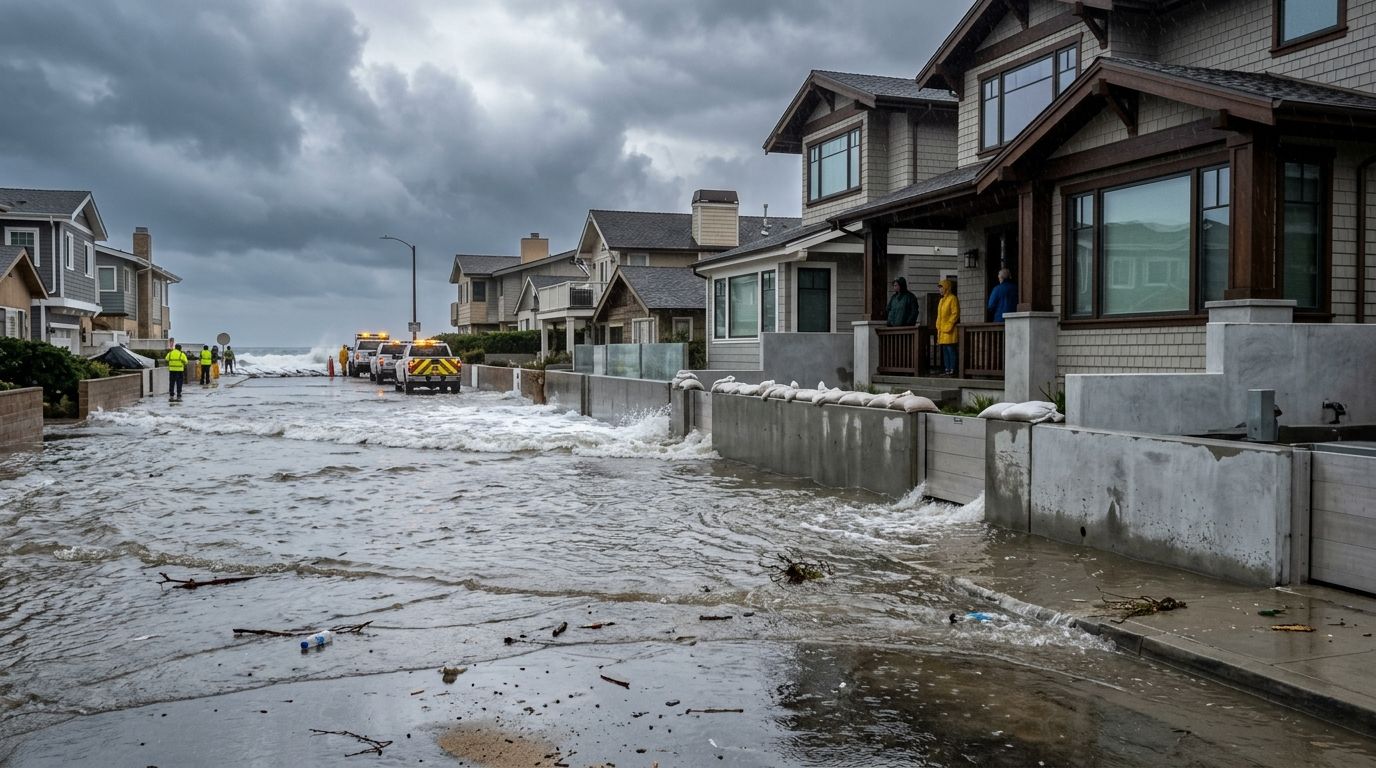
The Saltwater Defense Playbook:Protecting Your Home from Foundation to Roof
Ocean storm surge and high King Tides are not ordinary rain floods. Saltwater carries corrosive chlorides that silently destroy concrete rebar, rot framing lumber, and create catastrophic electrical & EV battery fire hazards. Here is your engineered survival protocol.
Interactive Home Zone Inspector: Foundation to Roof
Select any structural zone below to see specific saltwater threats, immediate emergency steps, and permanent contractor solutions.
Saltwater Chloride Attack & Concrete Spalling
Concrete acts as a porous sponge. Ocean saltwater carries chloride ions straight into internal steel rebar, causing it to rust, expand up to 600%, and blow apart the structural concrete stem wall (spalling).
Immediate Triage (What You Must Do Now):
- Inspect stem walls for sudden hairline cracks or white powdery deposits (efflorescence).
- Never seal wet concrete with standard paint or rubber coating—this traps destructive saltwater inside.
- Check for soil erosion or scouring under perimeter footings from receding tidal backwash.
SkillSee Engineered Solution:
Subterranean foundation excavation, crystalline waterproofing injection, carbon fiber reinforcement, and French perimeter drainage.
Explore Foundation Repair & StabilizationThe 72-Hour Saltwater Remediation Checklist
Every hour saltwater remains in contact with building materials multiplies structural loss. Check off each step as you complete it.
Hours 0–24: Immediate Life Safety & Saltwater Triage
Saltwater Damage & Corrosion Risk Calculator
Calculate your property's vulnerability level and find out what immediate intervention is required.
Severe danger of mudsill dry rot, Simpson bracket galvanic decay, and mold bloom within 48 hours.
Why Freshwater Protocols Fail Against Pacific Ocean Surges
Standard restoration franchises treat floodwater as simple moisture to be evaporated with hot air fans. But ocean water is chemically aggressive:
- Hygroscopic Salt Trap: When hot air evaporates moisture, sodium chloride (NaCl) stays behind in cellular wood cavities. Every foggy morning, that salt pulls water right back out of the marine atmosphere, making permanent natural drying impossible.
- Galvanic Decomposition: Dissolved salt creates an electrolytic bath between dissimilar metals (e.g., zinc screws in copper flashing or steel bolts in aluminum tracks), eating them away through accelerated galvanic corrosion.
- Concrete Alkali Leaching: Salt ingress destabilizes calcium silicate hydrate bonds, turning dense foundation concrete into crumbly chalk.
Realize Your Dream Project Today:
Stress-Free Financing
A large-scale renovation, ADU construction, or a whole-home update is an investment in your future. We understand that financial planning is a key stage of any project. That's why SkillSee, in partnership with HFS Financial, offers exclusive lending terms for our clients in Los Angeles.
* Inquiry does not affect your credit score
Coastal Flood & Saltwater Inundation FAQs
Expert answers to common questions about Los Angeles construction and remodeling.
Why can't I just use regular fans to dry saltwater flooding?
Regular fans only evaporate liquid water, leaving behind concentrated sea salt crystals. Salt is hygroscopic—it absorbs humidity from coastal air perpetually. As a result, wood framing and concrete will stay permanently damp and breed toxic mold unless thoroughly flushed with fresh water and treated before structural drying.
Are electric vehicles really a fire hazard after saltwater flooding?
Yes. Saltwater is a high-conductivity electrolyte. When it penetrates the sealed high-voltage lithium-ion battery pack, it causes immediate internal short circuits and violent thermal runaway fires. Standard fire hoses cannot easily extinguish battery fires. Any flooded EV must be parked outdoors at least 50 feet away from homes.
Does homeowners insurance cover storm surge and saltwater damage in Long Beach and Orange County?
Standard homeowners insurance policies exclude rising floodwaters and storm surges unless you carry separate NFIP (National Flood Insurance Program) or private flood insurance. However, related water backup, wind-driven moisture, and resultant reconstruction may qualify for coverage. SkillSee provides itemized Xactimate loss reports to maximize insurance reimbursement.
How does SkillSee stop salt from destroying concrete foundations?
We perform a multi-stage process: first, high-pressure freshwater washdown and chemical neutralizer extraction; second, deep moisture mapping; third, structural epoxy crack injection to seal fissures; and fourth, exterior cold-applied elastomeric waterproofing membranes with French perimeter drainage.
How quickly can SkillSee deploy emergency crews to coastal areas?
Our licensed emergency teams respond 24/7 across Long Beach (Belmont Shore, Naples), Huntington Beach, Seal Beach, Newport Beach, and surrounding coastal communities within 60 to 90 minutes.
Request Urgent Structural Flood Evaluation
Our licensed structural engineers and master contractors serve Long Beach, Huntington Beach, Seal Beach, and greater coastal Southern California.
